Watts & Bills
The beer fridge in the garage costs more than you'd guess
An old second fridge in a hot garage quietly costs about $218 a year in New South Wales - and it is working harder than the one in your kitchen.
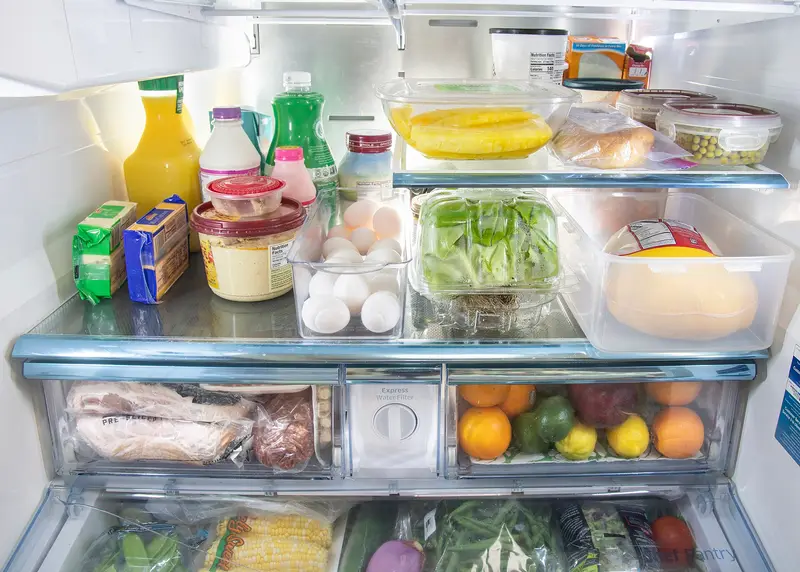
Photo: Food Safety - Cut Waste in Refrigerators (20200605-FSIS-LSC-0059) by USDAgov, Public domain
The second fridge is the most common piece of hidden spending in an Australian home. It is usually the old kitchen fridge, it usually lives in the garage, it usually holds drinks and a bag of ice, and it is almost always the least efficient appliance on the property.
| State | Rate | Per day | Per year |
|---|---|---|---|
| Tasmania | 27.95c | 50c | $184 |
| Queensland (south-east) | 27.97c | 50c | $184 |
| Victoria | 28.2c | 51c | $185 |
| Northern Territory | 31.68c | 57c | $208 |
| New South Wales | 33.14c | 60c | $218 |
| Western Australia | 33.26c | 60c | $219 |
| Australian Capital Territory | 36.95c | 67c | $243 |
| South Australia | 41.91c | 75c | $275 |
Why the garage makes it worse
A fridge does not make cold. It moves heat from inside the box to the room around it, and the hotter that room is, the harder it has to work. A garage in a Brisbane or Perth summer sits well above the air-conditioned kitchen the fridge was designed for, which is why the same unit that used 1.4 kWh a day indoors can use 1.8 or more outdoors.
Add the age factor. A fridge from 2008 uses roughly twice the electricity of a modern equivalent for the same internal volume, and its door seals have had fifteen years to go hard.
Put together, the honest comparison is not “a bit more than the kitchen fridge”. It is this:
| Second fridge in the garage75W, 24h per day | 60c per day | $218 a year |
| Fridge-freezer58W, 24h per day | 46c per day | $168 a year |
The second fridge costs about 30 per cent more to run than the main one, while holding a fraction of the food.
What it is actually buying you
This is the only question worth asking, and it is not rhetorical. Roughly $218 a year in New South Wales, $275 in South Australia. Some households genuinely get their money’s worth - a big family, a home business, a serious cook with bulk meat, someone an hour from the nearest shop. That is a fair trade.
For the rest, the fridge is cooling six cans and a half-empty bottle of soda water for the price of a decent pair of shoes every year.
Three things worth doing before you decide:
- Fill it or switch it off. A half-empty fridge cycles more than a full one. If it is not full, it is not earning its keep.
- Move it out of the heat if you keep it. Even getting it off a sun-facing wall and leaving 50mm of air behind it makes a measurable difference.
- Check the seal. Shut the door on a banknote. If it slides out without any grip, the seal is gone and you are chilling the garage.
Assumptions
We model the second fridge at an average 75W draw across 24 hours - about 1.8 kWh a day - which is typical for a 10-to-20-year-old unit in an unconditioned space, against 58W for a modern 400L fridge-freezer indoors. Figures use flat 2026-27 reference rates and exclude the daily supply charge. The sticker on your own unit, or twenty dollars’ worth of plug-in power meter, will beat our estimate every time. Method here.
Sources
- AER - Default Market Offer 2026-27 final determination
- Reference plan rates by state, 2026-27
- Appliance wattages are typical mid-range values for common Australian models. The label on your own unit beats our figure.
Reference prices last checked 2026-10-26. New regulated prices apply from 1 July each year. Spotted something wrong?Tell us — corrections go out the same week.